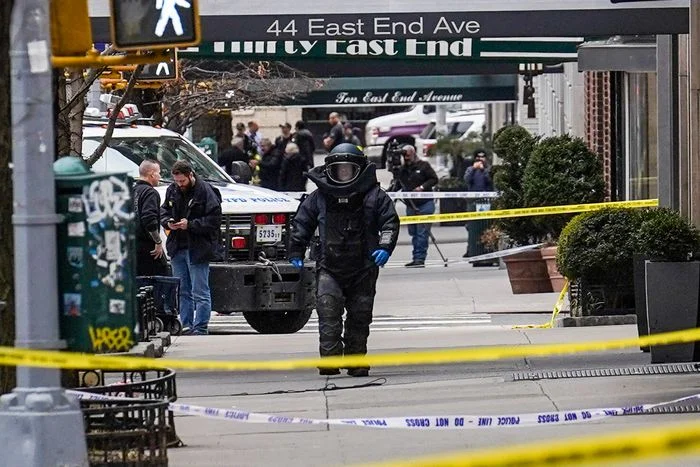
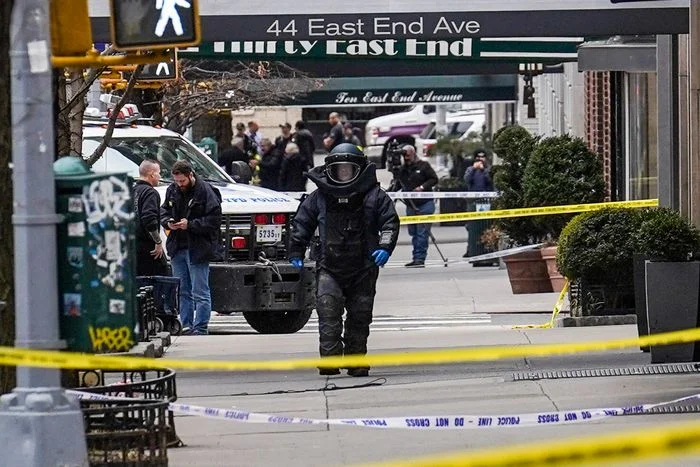
“There goes our quiet neighborhood,” says a man who lives in my building as we enter our lobby on East End Avenue. A newly installed gated security barrier sits outside in the nearby intersection; the flashing police and ambulance lights of vehicles lining the block create a chaotic scene. Before heading up to my apartment, I stop to pick up a package at our front desk.
“They’re saying it’s a suspicious device or something,” my doorman says, shrugging.
The NYPD has, for the second time in less than a week, closed off the roads surrounding Gracie Mansion (my building is directly across the street from it). This time, it is testing an object reported by a city worker in Carl Schurz Park, the 15-acre riverside green space bordering the mansion. The area is still on high alert after this past weekend’s anti-Muslim protest, which culminated in two ISIS-inspired young men throwing improvised explosive devices into the gathered crowd. My doorman, who has been working at our Upper East Side building for more than 40 years, says he can’t remember anything like this happening before. “Yeah, we’ve had protests, Black Lives Matter. One time after 9/11, someone saw a suitcase in a car and the whole place was evacuated,” he says. “But this feels different.” I agree.
My husband and I moved into our apartment on East End a decade ago. After spending my 20s and early 30s bouncing around downtown — Nolita, Chelsea, Greenwich Village, the East Village — I was ready for somewhere peaceful and clean, somewhere with wide sidewalks and flowers and lots of swings. Yorkville fit the bill perfectly. Our place hadn’t been renovated in maybe 50 years (hello, pastel-pink bathrooms!), but it was well priced and our building was nice. We figured we’d fix it up eventually, by which we apparently meant ten years later. But the best part of the apartment, still, is the view; we face Carl Schurz with its abundant trees and winding paths. Were it not for the FDR to the left and the East River skyline beyond that, you could be in the suburbs.
We’re now on our third mayor-neighbor, but I never saw Bill de Blasio around (he seemed to prefer his home turf of Park Slope), and Eric Adams’s reign was mostly notable for the “cultural” evenings that pumped music at high volumes late into the night. (I know it sounds fun, but not when you have two children who have to sleep.) When Zohran Mamdani moved in, it was a press-worthy event, underscoring the fact that he had left behind his rent-stabilized apartment in Astoria and, unlike other recent mayors, had no other address to call home. The reason for the move seems prescient in retrospect; as he said, “This decision came down to our family’s safety.” So far, his term, just over two months in, has proven to be the most eventful of all.
“After Mamdani won, I was joking with my friends, saying as soon as he moves here, that’s when the threats are going to start,” says a young woman who lives on 87th near York. “Everyone laughed, but it turned out to be true.” She’s walking her dog to Carl Schurz, and mid-phone call with her mom. She says that she wished there were more communication about the threat level to local residents. “I’m trying to figure out where to walk my dog right now. If it’s dangerous, I need a heads-up.” I tell her to head west for the time being.
I get a text from a friend who lives on East End and 84th. Like me, she has two young kids who go to school in the neighborhood. “My daughter was totally freaked out walking home from Asphalt Green over the weekend when she saw all the police and men in black masks,” my friend writes. My sons seemed more curious than scared, tracking the helicopters and drones from our window. My husband inadvertently walked through the weekend protest while running errands, before it became clear it was getting out of control. When he saw a bunch of protesters carrying a whole pig wrapped in aluminum foil — a jab at the Muslim prohibition against eating pork — he texted me, “It’s not nice out here at all. I’d recommend staying in.” We did until later that afternoon, when everything had calmed down. “Be careful,” my doorman said to us on our way out. The news crews were out in full force. We walked in the opposite direction.
On Tuesday, I approach a small group of 60-something men talking outside a building on 85th Street. It’s a common scene around here; when the weather is nice, people congregate under awnings, chatting with doormen and one another.
“To protest is fine, but when you start planting bombs, it’s wrong,” says one man, whose name is Ed.
“I’ve been here since before Bloomberg was mayor,” says another, whose name is also Ed. (“Just call us The Eds,” says the second Ed.)
“Since before Christ?” says Ed No. 1.
“That’s who built Gracie Mansion,” says Ed No. 2. They both laugh.
“There used to be cops who did foot patrols, and then Bloomberg didn’t live here, so the foot patrols went away,” says Ed No. 2. “What happened this weekend is an indication of what’s wrong with the country right now,” he says. They both think the foot patrols should restart.
A woman passes by, walking toward East End. She clearly knows The Eds. “Back to normal again?” she asks as she passes by. “Fingers crossed!” They give her a thumbs-up.
Not everyone is so upbeat. “The people in this neighborhood didn’t vote for Mamdani, and we don’t like that he’s here,” says an employee of a local business. “Would have been better if he’d stayed where he was. This is a quiet neighborhood. We don’t need this.” Much has been made of the fact that Yorkville overwhelmingly voted for Cuomo (64 percent to Mamdani’s 33 percent), but I don’t get the sense that most people are blaming Mamdani for the violence in our backyard.
“The world is a very volatile place right now,” says an older woman who lives on 88th Street. She’s standing near her building with her neighbor, who’s in a wheelchair. “With Mamdani there, with everything else going on … there will be more of this,” she says, referring to last weekend’s events.
Before I head home, I stop into Mansion Diner on York and 86th. The restaurant has been in business for 80 years, and its décor features historical photographs of East End that date back to when the FDR was a beach instead of a highway. I speak with the owner, Phil Philips, whose father opened the Mansion in 1945 and who was born on the block — there used to be a hospital on 86th between York and East End — and still lives here.
He’s feeling somewhat blasé about the whole thing. “1967 was the race riots, ’69 was Vietnam, ’71 was Nelson Mandela. There’ve been a number of Al Sharpton things; more recent was Black Lives Matter. There’s always something going on ’cause of Gracie Mansion,” he says. The difference this time, he says, is the way the police were treated by the protesters. “The police on York Avenue had a barricade, just standing there, not doing anything. And they were taunted by the protesters, getting abused for no reason. I come from a different time, when the police could react to being attacked. I’m not saying that’s a good thing, but I’m not saying that’s a bad thing, either. I’ve been on the other side of a billy club before — not for protesting.”
The new mayor hasn’t come into the diner to grab a bowl of its famed matzo-ball soup, but “if he comes, he’s more than welcome,” says Philips. “We’ve fed every Mayor since Impellitteri.” (I had to Google it — Vincent Impellitteri was Mayor from 1950 to 1953.)
By the time I get back to my East End building, the police barricades are gone and the block is open again. It turns out the suspicious package was a false alarm. Over on Reddit, residents on r/uppereastside are informing others that it’s safe to go back into the park. The protests have eclipsed dog-poop complaints as the hot topic of the day. “Take this crap back to Washington Square Park where it belongs,” writes one commenter. I look out my window to see if I can spot Mamdani or any other police activity, but all’s quiet at Gracie Mansion and on the rest of the block. For now.